
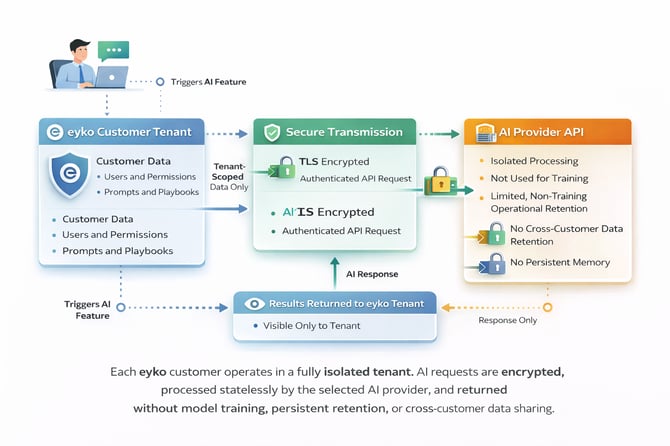
Summary
• Customer data is encrypted in transit and securely processed.
• Data is not used to train AI models.
• There is no cross-customer data sharing or learning.
• Each customer operates in a fully isolated tenant.
• AI behavior is driven by customer-specific configuration, not shared model memory.
1. Does eyko send customer data to third-party AI providers?
Yes, when AI features are used, eyko securely sends relevant data to a selected AI model provider through their enterprise API.
eyko does not use consumer AI products or shared public interfaces. All interactions occur through secure, contractual, API-based integrations.
2. How is data protected when sent to an AI provider?
Data is protected using industry-standard security controls.
• All data is encrypted in transit using TLS 1.2 or higher.
• Requests are authenticated using securely managed API credentials.
• Data is processed only for the duration required to generate a response.
3. Is customer data used to train AI models?
No.
Customer data sent from eyko to any AI provider is not used to train, retrain, or improve foundation models.
eyko only uses AI providers that contractually separate customer API data from model training unless a customer explicitly opts in. eyko does not opt in to model training.
4. Is customer data stored by AI providers?
AI providers may temporarily retain limited request data for operational purposes such as abuse detection, system reliability, or performance monitoring.
• Retention is limited in duration.
• Data is not used for training.
• Data is not shared across customers.
• Stricter retention or zero-retention configurations may be available depending on customer requirements.
5. Can insights or “learning” from one customer be applied to another?
No.
There is no cross-customer learning.
• Each eyko customer operates in a fully isolated tenant.
• AI requests are executed within the context of that tenant only.
• Outputs from one customer cannot influence responses for another customer.
• No customer data is reused, referenced, or inferred across tenants.
6. What does “AI learning” mean in eyko?
AI learning in eyko does not mean model training.
In eyko, “learning” refers to:
• Prompts and instructions configured within a customer’s tenant.
• Business rules, playbooks, and workflows defined by the customer.
• Historical data that already exists within that customer’s environment.
The underlying AI models do not persist memory or adapt based on customer interactions.
7. Do AI models remember previous conversations or customer data?
No, not independently.
Each AI request is processed independently unless eyko explicitly includes historical context from the customer’s own tenant. AI models do not maintain long-term memory of customer data.
8. How is tenant isolation enforced?
Tenant isolation is enforced at multiple layers.
• Each customer has a dedicated eyko tenant.
• Data storage, users, permissions, and AI interactions are tenant-scoped.
• Users authenticated into one tenant cannot access another tenant’s data.
• AI requests are strictly associated with the active tenant context.
9. Can AI provider employees access our data?
Access is tightly restricted.
AI providers apply role-based access controls and limit internal access to customer data on a strict need-to-know basis, aligned with SOC 2, ISO 27001, and similar security frameworks.
10. What compliance standards does this architecture support?
The eyko AI architecture supports alignment with:
• SOC 2 Type II
• ISO 27001
• GDPR and CCPA principles
• Enterprise data protection best practices